CarTRidge cruise report

Updated: Feb 28
'Drifting over the Lake District in an airship at a height of 3000 metres and trying to drop a rock onto a barn roof. At night' ~ Chief Scientist Professor Jonathan Sharples
Those are the words used by the Principal Scientific Officer of research cruise JC275 (CarTRidge) to describe our expedition across the south Atlantic Ocean in the austral summer of 2025. In fact, he is referring not to the terrestrial mountain range in north England, but rather to the divergent plate boundary that runs down the middle of the Atlantic Ocean, separating the North and South American plates from the Eurasian and African plates. This, the mid-Atlantic ridge, forms part of the longest mountain range in the world, extending over 16,000 kilometres. And, rather than an airship, we were aboard the British Royal Research Ship James Cook, dropping not a rock, but state-of-the art oceanographic equipment to the ocean depths, in the hopes of answering fundamental questions about the impact of this ridge on our marine ecosystems and biogeochemical cycles.
Between February and April 2025, we sampled 5000 litres of seawater, sailed 4000 nautical miles, lived for 47 days at sea, and undertook 35 experiments, with 21 scientists aboard working towards a unified goal: to understand the role phytoplankton in our surface ocean play in the global carbon cycle, their interaction with such geological features, and how this relationship will impact, and be impacted by, our changing climate.

The ocean is likened to many things—the ‘lungs’ of the planet, the earth’s ‘air conditioner’, an aquatic ‘rainforest’—but the bottom line is this: without a healthy ocean, human life could not be sustained on Earth. It absorbs 90% of the excess heat generated by human activity, produces oxygen for every second breath we breathe, and absorbs half of the carbon dioxide from our atmosphere, despite representing just 1% of photosynthetic biomass. Yet, these duties are taking their toll and with a rapidly changing climate, it can’t continue to do these things indefinitely. Ocean warming, acidification and pollution are just a few of the challenges facing our marine world today. And it’s crucial we understand how our ocean is changing in response to these things, so we can make accurate predictions on the future of our planet and its ecosystems.
As such, our task on expedition JC275 was to look at how the specific environment on the mid-Atlantic ridge, with its internal tides altering the light, nutrient and mixing regimes experienced by its local phytoplankton communities, impacted the ability of these communities to capture carbon and export it to the ocean’s depth. Within the team of 21 scientists, we five members of ‘Team Plankton’ were responsible for interrogating the biological aspect of the picture. We approached this in two ways: by looking at the natural plankton communities and observing changes over a vertical gradient, from the surface to the deep chlorophyll maximum (DCM), and by conducting shipboard nutrient addition experiments, investigating the impacts of alleviating nutrient stress on phytoplankton community structure and function.
In the pursuit of these answers to these questions, we awoke each day between the hours of midnight and 3am, rising before the sun so as not to shock our photosensitive deep photic plankton (if you’re curious to see what a day on the ship was like, click here!) We collected our samples using a Conductivity, Temperature, Depth (CTD) instrument which, as well as bringing back 24x 20L Niskin bottles full of seawater from various depths, provides real-time information about the temperature, fluorescence, salinity, turbidity and oxygen concentration of the water below us.

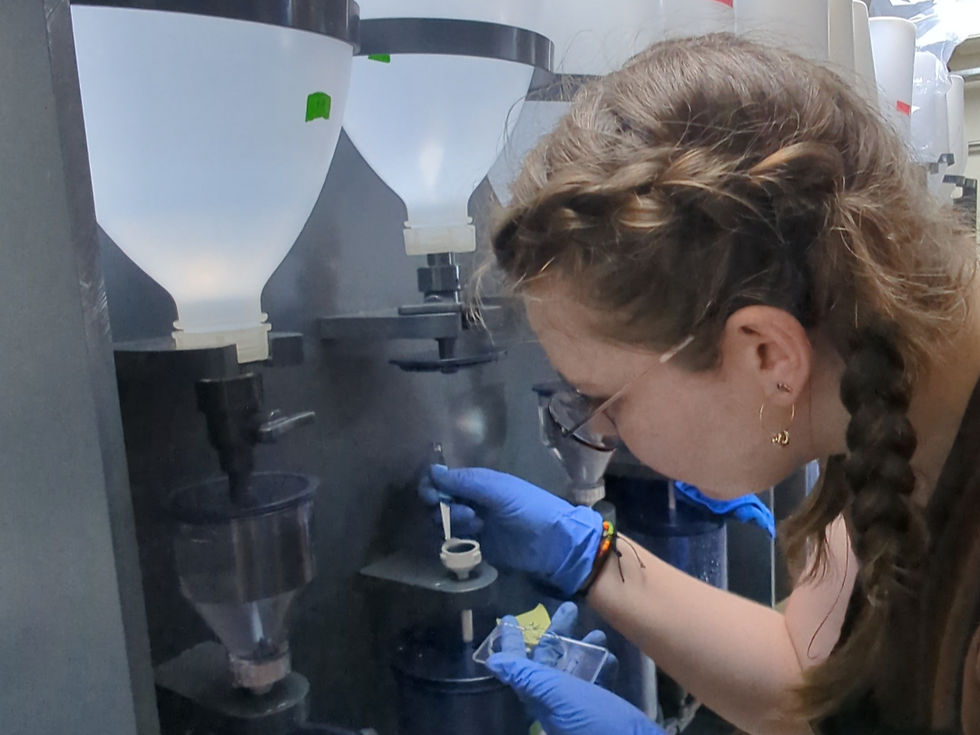
Thus began a flurry of filtering, fixing and analysis. We took our hundreds of litres of water back to light- and temperature-controlled laboratories, where we analysed the chlorophyll content of our samples, the photosynthetic efficiency of the plankton within (Fv/Fm) and bottled water with fixative for analysis with a ’flow cam’, a plankton imager which would enable us to observe directly the plankton in our samples. We filtered for scanning electron (SEM) and light microscopy, high performance liquid chromatography (HPLC) and fixed samples for flow cytometric analysis, all of which would allow us to interrogate the ‘who’s who’ of plankton at each point along a vertical (depth) and horizontal (longitude) gradient.
Whilst we sampled CTDs most days, some days were extra special (and with an extra early alarm!). These mornings saw us meeting in our trace-metal clean container lab (affectionately named ‘Steve’) just after midnight, to carry out our nutrient addition experiments. Each experiment lasted a week, sampling at the beginning, middle and end. During these experiments we sampled not from the CTD but surface water from a trace-metal free sampling device called a tow-fish, suspended over the ship’s side and dragged along with us. This allowed us to add macro- and micro- nutrients like nitrogen and iron, and observe the response of the natural plankton community in real time and high resolution, taking most of the same measurements as for our CTD sampling. This classic oceanographic experiment allows us to understand which nutrients are limiting at a given point in the ocean—here an on- vs off-ridge comparison—and how these communities respond to the alleviation of nutrient stress, both in terms of community structure (i.e. who wins and loses) but also the genetic basis of rapid adaptation to changing conditions.

Perhaps most excitingly, over the course of the cruise I was able to filter thousands of litres of seawater for genetic analysis. Over the next year I will work with collaborators around the country to carry out metabarcoding and metatranscriptomics analysis of the samples we’ve collected over the last months. This is an exciting avenue, allowing us to investigate these communities in unparalleled resolution, unpicking the genes and gene pathways involved in adaptation to life under rapidly changing conditions. The data will produce a novel genetic database of the south Atlantic picoplankton community, show patterns of nutrient limitation and reveal the functional responses in community structure, trophic mode and gene expression of natural phytoplankton communities to changing nutrient, light and mixing regimes.

Life at sea is not for the faint of heart. The hours are long, the work is both physically and mentally challenging and evenings and weekends aren’t in the question. And yet, I’m never happier than I am at sea. The total immersion in the subject I love, seeing nothing but the ocean for miles, and being surrounded by inspiring people who are passionate about the same things as me is a life I feel privileged to live, and will do everything I can to continue. Moreover, for an early career scientist, sitting bleary-eyed at breakfast (which was, for us, more like lunch!), eating toast across from some of the most eminent names in oceanography is a career-defining experience.
My deepest thanks to Professor Alex Poulton for inviting me to take part in this expedition and his support throughout the planning and work, and to Frieda Schlegel, Ben Fisher and Barbara Duckworth of Team Plankton for being wonderful colleagues and friends. Thanks to Professor Jonathan Sharples and the scientists, technicians and crew of JC275 for their hard work and camaraderie throughout. And to my funders, the UKRI BBSRC, St John’s College, Oxford, and the Challenger Society for Marine Science for facilitating my partaking in this expedition and research.
Comments